


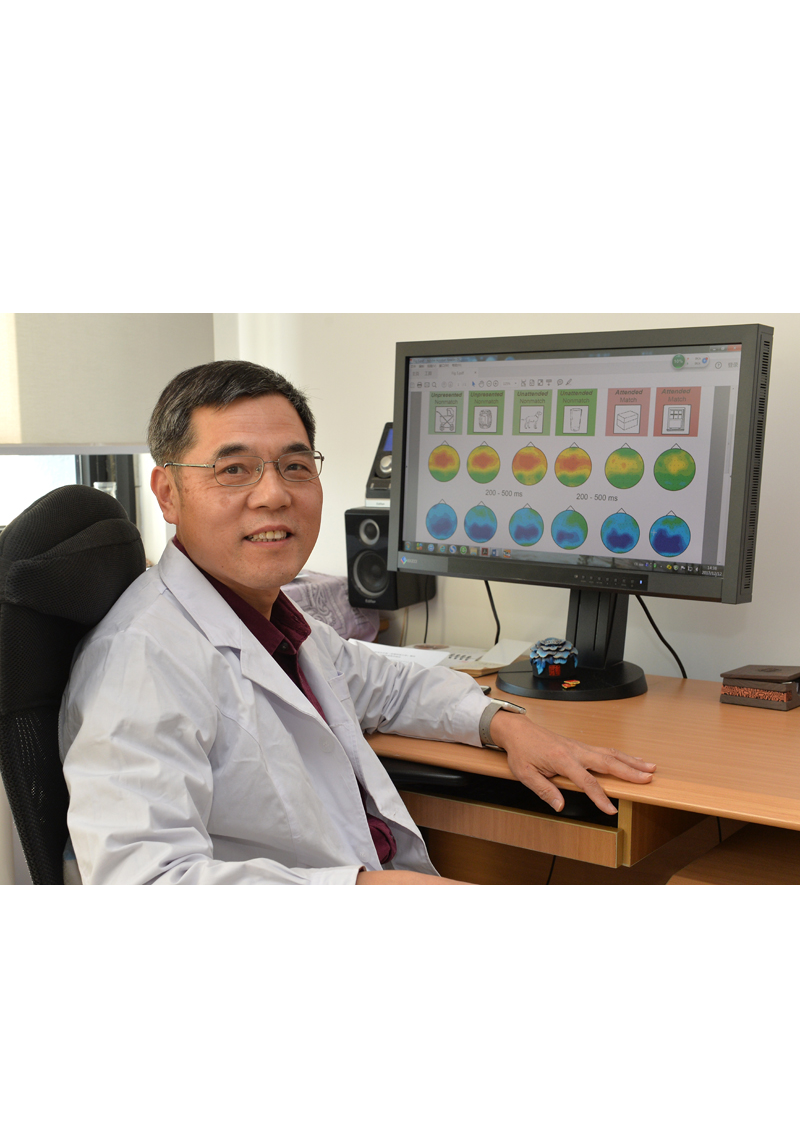
师资队伍——郭春彦
个人基本情况:
郭春彦,教授,博士生导师,首都师范大学资深教授,
《心理科学进展》副主编 (2021年-2025年)
中国心理学会第二批认定的心理学家(2010年5月)
通信地址:北京市海淀区白堆子甲23号院(首都师范大学东校区)首都师范大学心理学院;100073
Email:guocy@cnu.edu.cn
研究领域
认知神经科学
人类记忆过程的神经机制
教育背景
1996.9—2000.7 北京大学毕业,获心理学博士学位
1986.9—1989.7 首都师范大学毕业,获心理学硕士学位
1978.3—1982.2 北京师范学院毕业,获理学学士学位
工作经历
1982.3—1987.11 助教,北京师范学院(首都师范大学)
1987.11—1992.11 讲师,首都师范大学
1992.11—1997.11 副教授,首都师范大学
1997.11—现在 教授,首都师范大学
荣誉奖励
2010年荣获北京市第十一届哲学社会科学优秀成果(论文)一等奖(排名第一)
2012年荣获北京市第十二届哲学社会科学优秀成果(论文)二等奖(通讯作者)
2006年荣获北京市第九届哲学社会科学优秀成果(论文)二等奖(排名第一)
1998年荣获北京市第五届哲学社会科学优秀成果(论文)二等奖(排名第一)
1996年两本著作荣获北京市第四届哲学社会科学优秀成果二等奖(排名第二)
2016年被聘为首都师范大学资深教授
2014年被聘为首都师范大学燕京学者
2013年获北京市优秀教师称号
2008年被聘为首都师范大学人文社会科学和自然科学研究院研究员
2007-2008、2009年度入选首都师范大学研究生培养“优秀导师”
2006年获北京市拔尖创新人才称号
2005年获北京市高校优秀共产党员称号
1999年入选北京市跨世纪优秀人才工程
1995年入选北京市优秀青年骨干教师
学术兼职与学术经历
中国心理学会理事
中国心理学会普通心理、实验心理专业委员会委员
《心理学报》(2014-2017)、《应用心理学》和《心理与行为研究》编委
教育部--“国家级教学成果奖评审”专家组成员(2005)
教育部--“国家级精品教材评审”专家组成员(2005)
国家自然科学基金委员会--“国家重点实验室评审”专家组成员(2006)
“十一五国家科技支撑计划——心理疾患防治研究与示范”评审专家(2009)
国家自然科学基金委员会科普学部专家评审组评审专家(2010)
国家自然科学基金委员会生命科学部专家评审组评审专家(十三届,十四届,2015,2017)
北京市科学技术奖评审专家(2011)
2003.1-2004. 3.30 美国 Northwestern University Psychology Department访问学者
2006.8.10-2007.3.10 美国University of Kentucky Behavior Department 访问学者
2009.9.18-2009.11.19 美国University of Kentucky Behavior Department 访问学者
2012.11.7-2012.12.23 美国University of Kentucky Behavior Department 访问学者
科研项目(主持)
国家自然科学基金:“联结再认的心理与神经机制:熟悉性与回想的作用”;主持:(2017.1- 2020.12),项目号:31671127。
国家自然科学基金:“人类记忆过程:概念启动与熟悉性的神经机制”;主持:(2013.1- 2016.12),项目号:31271078。
国家自然科学基金:“工作记忆与情景记忆重复效应的神经机制研究”;主持:(2009.1-2011.12),项目号:30870760。
国家自然科学基金:“工作记忆与情景记忆关系的神经机制研究”;主持:(2006.1-2008.12),项目号:30570603。
国家自然科学基金:“记忆编码与提取的神经过程及其相互关系的研究”;主持:(2002.1-2004.12),项目号:30170322。
高等学校博士学科点专项科研基金:“工作记忆和情景记忆中概念启动神经机制的研究”; 主持:(2011.1-2013.12),项目号:20101108110004。
北京市教委重点课题:“人类记忆——新旧效应与重复效应的神经机制研究”;主持:(2010.1-2012 .12), 项目号:KZ201010028029。
北京市拔尖创新人才项目资助:“人类记忆过程的神经机制研究”;主持:(2007.1-2009.12)。
高等学校博士学科点专项科研基金:“工作记忆中编码过程的神经机制研究”;主持:(2005.1-2006.12), 项目号:20040028001。
主要学术论文(发表于2004之后第一作者与通信作者论文)
(一)、SCI、SSCI收录
1. Jiaojian Dai, Peipeng Liang, Xiaohuan Li, Jingwei Zhang, Liuqing Tian, Xinrui Mao* Chunyan Guo*(2025)Semantic predictability and semantic relevance through different neural mechanisms to improve memory performance,Brain and Cognition,doi.org/10.1016/j.bandc.2025.106300
2. Jingwei Zhang,Jiaojian Dai,Liuqing Tian,Zhihe Xu,Mingxia Zhang,Peng Zhang, Chunyan Guo*,Qi Li*(2024)Improving memory through choice and deliberation in decision- making: Evidence from ERPs,Psychophysiology ,DOI: 10.1111/psyp.14662
3. Miaomiao Xie,Meng Han,Zejun Liu,Xian Li,Chunyan Guo*(2024)Effects of congruent emotional contexts during encoding on recognition: An ERPs study. Psychophysiology,DOI: 10.1111/psyp.14516.
4. Jianqin Cao, Feng Si, Yanru Zhan, Guozhong Gu, Chunyan Guo*(2023)Social anxiety modulates emotion processing for social threat words: Evidence from ERP. Neuroscience Letters,https://doi.org/10.1016/j.neulet.2023.137498.
5. Chunyu Zhao, Yun Chen, Zaizhu Han, Chunyan Guo*(2023)Chinese character unitization enhances item memory in addition to associative memory: Evidence from ERP and TFR. Biological Psychology,https://doi.org/10.1016/j.biopsycho.2023.108644.
6. Chunyu Zhao, Yubin Peng, Zejun Liu, Ping Wei*, Chunyan Guo*(2023)Chinese character unitization enhances recollection-based associative recognition: Evidence from fMRI. PsyCh JOURNAL, DOI: 10.1002/pchj.663.
7. Jianqin Cao, Feng Si, Xiaohuan Li, Chunyan Guo* , Xiaodong Yue(2022)The effects of social anxiety on recognition memory for social threat words: An ERP study. Biological Psychology,https://doi.org/10.1016/j.biopsycho.2022.108420
8. Jianqin Cao, Feng Si , Xiaohuan Li, Chunyan Guo*(2022)The neural correlates of social anxiety modulating conflict-driven cognitive control: An ERP study. Neuroscience Letters,https://doi.org/10.1016/j.neulet.2022.136721
9. Jian Sun, Yi Liu, and Chunyan Guo*(2022)The impacts of the processing levels on testing effect。NeuroReport DOI: 10.1097/WNR.0000000000001786
10. Meng Han, Bingcan Li, Chunyan Guo*, Roni Tibon* (2022) Effects of emotion and semantic relatedness on recognition memory: Behavioral and electrophysiological evidence. Psychophysiology, https://doi.org/10.1111/psyp.14152
11. Zejun Liu, Xian Li, Xiaohuan Li, Jing Yuan, Chunyan Guo*(2022)From encoding to retrieval: Change in level of unitization resolves debate about Unitization's effect on associative recognition,Psychophysiology, https:// doi.org/10.1111/psyp.14161
12. Xi Jia, Chuanji Gao, Baoming Li, Svetlana V. Shinkareva, Chunyan Guo*(2021)Effects of retrieval and emotion on within-item associative memory – Evidence from ERP and oscillatory subsequent memory effects. BIOLOGICAL PSYCHOLOGY, doi.org/10.1016/j.biopsycho.2021.108222
13. Yurao Ma, Zejun Liu, Chunyu Zhao and Chunyan Guo*(2021)Unitization congruence moderates the effect of unitization on associative recognition: evidence from event-related potentials. NeuroReport, DOI: 10.1097/WNR.0000000000001735.
14. Chuanji Gao, Wanze Xie, Jessica J. Green, Douglas H. Wedell, Xi Jia, Chunyan Guo*, Svetlana V. Shinkareva*(2021)Evoked and induced power oscillations linked to audiovisual integration of affect. BIOLOGICAL PSYCHOLOGY, DOI: 10.1016/j.biopsycho.2020.108006.
15. Guixiong Liu, Yujuan Wang, Yongping Jia, Chunyan Guo*(2021)Unitization facilitates familiarity-based cross-language associative recognition. Neuroscience Letters https://doi.org/10.1016/j.neulet.2020.135501
16. Zejun Liu,Chunyan Guo*(2020)Unitization could facilitate item recognition but inhibit verbatim recognition for picture stimuli: behavioral and event‑related potential study. Psychological Research, https://doi.org/10.1007/s00426-020-01442-w.
17. Baoqing LuI, Zejun LiuI, Yujuan Wang Chunyan Guo*(2020)The different effect s of concept definition and interactive imagery encoding on associative recognition for picture and word stimuli. International Journal of Psychophysiology,https://doi.org/10.1016/j.ijpsycho.2020.09.012.
18. Zejun Liu,Yujuan Wang,Chunyan Guo*(2020)Under the condition of unitization at encoding rather than unitization at retrieval, familiarity could support associative recognition and the relationship between unitization and recollection was moderated byunitization-congruence. Learning and Memory ,www.learnmem.org/cgi/doi/10.1101/lm.051094.119.
19. Zejun Liu, Jun Wu, Yujuan Wang, Chunyan Guo*(2020)Unitization does not impede overall item recognition performance: behavioral and event-related potential study. Neurobiology of Learning and Memory,https://doi.org/10.1016/j.nlm.2019.107130.
20. Xi Jia, Chuanji Gao, Lixia Cui, Chunyan Guo*(2020)Neurophysiological Evidence for the Retrieval Practice Effect under Emotional Context. International Journal of Psychophysiology https://doi.org/10.1016/j.ijpsycho.2019.12.008.
21. Jie Zhang, Xiaohuan Li, Chunyan Guo*(2020)The neurocognitive features in survival 1 processing: an ERP study. International Journal of Psychophysiology https://doi.org/10.1016/j.ijpsycho.2019.10.012.
22. Zejun Liu, Jun Wu, Chunyan Guo*(2019)The Effect of unitization on Associative Recognition was not moderated by the Unitization-Congruence between original and rearranged picture pairs (UC) for picture stimuli. Psychological Research, DOI: 10.1007/s00426-019-01260-9
23. Bingbing Li,Chuanji Gao, Wei Wang, Chunyan Guo*(2019)The effect of conceptual priming on subsequent familiarity: Behavioral and electrophysiological evidence. Biological Psychology, doi:10.1016/j.biopsycho.2019.107783
24. Xi Jia, Chuanji Gao, Lixia Cui, Chunyan Guo*(2019)The role of emotion arousal in the retrieval practice effect. Experimental Brain Research, doi: 10.1007/s00221-019-05658-0
25. Yi Liu, Xinrui Mao, Yubin Peng, Baoqing Lu and Chunyan Guo*(2019)Dissociating neural correlates of retrieval practice and elaborative study in associative recognition memory. NeuroReport, doi: 10.1097/WNR.0000000000001301.
26. Bingcan Li, Meng Han, Chunyan Guo*, Roni Tibon*(2019) Unitization modulates recognition of within‐domain and cross‐domain associations: Evidence from event‐related potentials. Psychophysiology. DOI: 10.1111/psyp.13446.
27. Xue Yang, Xinrui Mao, Meng Han, Xian Li and Chunyan Guo*(2019) Electrophysiological evidence of encoding in self-referential effect. NeuroReport, DOI: 10.1097/WNR.0000000000001303.
28. Zejun Liu and Chunyan Guo*(2019)Unitization improves item recognition through less overall neural processing. NeuroReport, DOI: 10.1097/WNR.0000000000001296
29. Jie Zhang, Xiaohuan Li and Chunyan Guo*(2019)Animate words facilitate noun–noun integration during an imagery task: an event-related potential study. NeuroReport, DOI: 10.1097/WNR.0000000000001264.
30. Xi Jia, Chuanji Gao, Yujuan Wang, Meng Han, Lixia Cui*, and Chunyan Guo*(2019) Emotional Arousal Influences Remembrance of Goal-Relevant Stimuli. August 15. Emotion, http://dx.doi.org/10.1037/emo0000657.
31. Yubin Peng Yi Liu and Chunyan Guo*(2019)Examining the neural mechanism behind testing effect with concrete and abstract words. NeuroReport,doi: 10.1097/WNR.0000000000001169
32. Meng Han, Xinrui Mao, Nika Kartvelishvili, Wen Li, Chunyan Guo*(2018)Unitization mitigates interference by intrinsic negative emotion in familiarity and recollection of associative memory: Electrophysiological evidence. Cognitive, Affective, & Behavioral Neuroscience,https://doi.org/10.3758/s13415-018-0636-y,
33. Xi Jia, Chuanji Gao, Lixia Cui and Chunyan Guo*(2018)Does emotion arousal influence the benefit received from testing: insights from neural correlates of retrieval mode effect. NeuroReport,DOI: 10.1097/WNR.0000000000001130。
34. Wei Wang, Bingbing Li, Chuanji Gao, Chunyan Guo*(2018)The temporal dynamics of perceptual and conceptual fluency on recognition memory. Brain and Cognition, doi.org/10.1016/j.bandc.2018.07.002,
35. Xinrui Mao,Yujuan Wang,Yanhong Wu*,Chunyan Guo*(2017)Self-referential information alleviates retrieval 1 inhibition of directed forgetting effects——An ERP evidence of source memory. Frontiers in Behavioral Neuroscience,doi.org/10.3389/fnbeh.2017.00187.
36. Yuan Lyu,Yujuan Wang,Xinrui Mao,Xian Li,& Chunyan Guo*(2017)Semantic Relationship Shared Between Words: Influence on Associative Recognition Supported by Event-Related Potentials. Neuroreport,doi:10.1097/WNR.0000000000000910.
37. Xinrui Mao,Mengxi Tian,Yi Liu,Bingcan Li,Yan Jin,Yanhong Wu* and Chunyan Guo*(2017)Can We Retrieve the Information Which Was Intentionally Forgotten? Electrophysiological Correlates of Strategic Retrieval in Directed Forgetting. Frontiers in Psychology,doi: 10.3389/fpsyg.2017.01480.
38. Bingbing Li,Jason R. Taylor,Wei Wang,Chuanji Gao,Chunyan Guo*(2017)Electrophysiological signals associated with fluency of different levels of processing reveal multiple contributions to recognition memory. Consciousness and Cognition, doi.org/10.1016/j.concog.2017.05.001.
39. Yi Liu,Timm Rosburg,Chuanji Gao,Christine Weber,Chunyan Guo*(2017) Differentiation of subsequent memory effects between retrieval practice and elaborative study. Biological Psychology,doi:10.1016/j.biopsycho.2017.05.010;Vol,127,134–147.
40. Bingcan Li,Xinrui Mao,Yujuan Wang and Chunyan Guo*(2017)Electrophysiological Correlates of Familiarity and Recollection in Associative Recognition: Contributions of Perceptual and Conceptual Processing to Unitization. Frontiers in Human Neuroscience,doi:10.3389/fnhum.2017.00125.
41. Cui-Hong Li, Xu He, Yu-Juan Wang, Zhe Hu and Chun-Yan Guo*(2017)Visual Working Memory Capacity Can Be Increased by Training on Distractor Filtering Efficiency. Frontiers in Psychology,doi: 10.3389/fpsyg.2017.00196.
42. Lixia Cui, Guangyuan Shi, Fan He, Qin Zhang, Tian P. S. Oei, and Chunyan Guo*(2016)Electrophysiological Correlates of Emotional Source Memory in High-Trait-Anxiety Individuals. Frontiers in Psychology,doi: 10.3389/fpsyg.2016.01039.
43. Yujuan Wang,Xinrui Mao,Bingbing Li,Wei Wang and Chunyan Guo*(2016)Dissociating the Electrophysiological Correlates between Item Retrieval and Associative Retrievalin Associative Recognition:From the Perspective of Directed Forgetting. Frontiers in Psychology,doi: 10.3389/fpsyg.2016.01754
44. Chuanji Gao,Timm Rosburg,Mingzhu Hou,Bingbing Li,Xin Xiao,Chunyan Guo*(2016)The role of retrieval mode and retrieval orientation in retrieval practice: insights from comparing recognition memory testing formats and restudying. Cogn Affect Behav Neurosci,DOI:10.3758/s13415-016-0446-z
45. Xiaoyu Cui,Chuanji Gao,Jianshe Zhou,and Chunyan Guo*(2016)Can color changes alter the neural correlates of recognition memory? Manipulation of processing affects an electrophysiological indicator of conceptual implicit memory. Neuroreport,doi: 10.1097/WNR.0000000000000652 - Volume 27 - Issue 14:1037-1045
46. Yujuan Wang,Xinrui Mao,Bingcan Li,Baoqing Lu and Chunyan Guo*(2016)Semantic memory influences episodic retrieval by increased familiarity. Neuroreport,doi: 10.1097/WNR.0000000000000613 - Volume 27 - Issue 10:717-790
47. Bingbing Li,WeiWang,Chuanji Gao,Chunyan Guo*(2016)Masked repetition priming hinders subsequent recollectionbut not familiarity: A behavioral and event-related potential study. Cogn Affect Behav Neurosci,DOI:10.3758/s13415-016-0431-6
48. Huifang Xu,Qin Zhang,Bingbing Li,Chunyan Guo*(2015)Dissociable effects of valence and arousal on different subtypes of old/new effect: Evidence from event-related potentials. Frontiers in Human Neuroscience,doi: 10.3389/fnhum.2015.00650
49. Xinrui Mao,Yuqi You,Wen Li and Chunyan Guo*(2015) Emotion impairs extrinsic source memory—An ERP study. Biological Psychology,doi: 10.1016/j.biopsycho.2015.07.005.
50. Bingbing Li, Chuanji Gao, Wei Wang and Chunyan Guo*(2015)Processing fluency hinders subsequent recollection: An electrophysiological study. Frontiers in Psychology,doi: 10.3389/fpsyg.2015.00863.
51. Wei Wang,Bingbing Li,Chuanji Gao,Huifang Xu,Chunyan Guo*(2015) Conceptual fluency increases recollection: behavioral and electrophysiological evidence. Frontiers in Human Neuroscience,doi: 10.3389/fnhum.2015.00377.
52. Wei Wang, Bingbing Li, Chuanji Gao, Xin Xiao and Chunyan Guo*(2015)Electrophysiological correlates associated with contributions of perceptual and conceptual fluency to familiarity,Frontiers in Human Neuroscience . doi: 10.3389/fnhum.2015.00321
53. Chuanji Gao , Molly S. Hermiller, Joel L. Voss and Chunyan Guo*(2015)Basic perceptual changes that alter meaning and neural correlates of recognition memory. Frontiers in Human Neuroscience doi: 10.3389/fnhum.2015.00049.
54. Xu He, Weiwei Zhang, Cuihong Li, Chunyan Guo*(2015) Precision requirements do not affect the allocation of visual working memory capacity. Brain Research 1602: 126-143
55. Xin Xiao, Heather D. Lucas, Ken A. Paller, Jin-hong Ding, Chun-yan Guo* (2014) Retrieval Intention Modulates the Effects of Directed Forgetting Instructions on Recollection. PloS ONE.9(8):e104701
56. Mingzhu Hou, Chuanji Gao, Jun Wu, Chunyan Guo* (2014)Neural correlates of familiarity and conceptual fluencyare dissociable at encoding. Chinese science Bulletin,59(28),3602-3609.
57. Mingzhu Hou, Adam Safron, Ken A. Paller, Chunyan Guo*(2013)Neural correlates of familiarity and conceptual fluency in a recognition test with ancient pictographic characters. Brain Research 1518: 48-60
58. Hong Chen, Joel L Voss, Chunyan Guo*(2012)Event-related brain potentials that distinguish false memory for events that occurred only seconds in the past. Behavioral and Brain Functions doi:10.1186/1744-9081-8-36
59. Xin Xiao, Di Zhao, Qin Zhang, Chun-yan Guo*(2012)Retrieval of concrete words involves more contextual information than abstract words: multiple components for the concreteness effect. Brain & Language 120,251-258
60. XIAO Xin, DING JinHong & GUO ChunYan*(2011) The effects of encoding and retrieval on the mechanism of item+context binding. Chinese science Bulletin,56(17), 2787-1798.
61. CHEN YanNi, GUO ChunYan* & JIANG Yang(2011) Neural basis for successful encoding and retrieval of prospective memory Science China 54(6)580-587.
62. Guo Chunyan* Chen Wenju Tian Tian Ken A Paller and Joel L Voss(2010) Orientation to learning context modulates retrieval processing for unrecognized words. Chinese science Bulletin 55(26):2966-2973.
63. Dong Liu, Chunyan Guo* and Jin Luo (2010) An electrophysiological analysis of maintenance and manipulation in working memory Neuroscience Letters(482)123-127
64. Liu Zhaomin, Guo Chunyan*, Luo Liang(2010) Attention and available long-term memory in an activation-based model Science China 53(6)742-752
65. Li Yueting, Li Qi, Guo Chunyan*(2009)Differences of relevance in implicit and explicit memory tests: An ERP study. Chinese science Bulletin,54(15),2669-2680.
66. Chunyan Guo*, Adam L. Lawson, Qin Zhang, Yang Jiang*(2008)Brain potentials distinguish new and studied objects during working memory. Human Brian Mapping, 29:441-452.(封面文章)
67. Chunyan Guo*, Adam L. Lawson and Yang Jiang(2007)Distinct neural mechanisms for repetition effects of visual objects.Neuroscience,149(4):747-759.
68. Liu Zhaomin Guo Chunyan*(2007)Interactions between working memory and selective attention. Chinese Science Bulletin, 52(20):2811-2819.
69. Chunyan Guo*, Li Duan,Wen Li, Ken A. Paller(2006)Distinguishing source memory and item memory: Brain potentials at encoding and retrieval. Brain Research,1118:142–154.
70. Chunyan Guo*, Joel L. Voss, Ken A. Paller(2005)Electrophysiological correlates of forming memories for faces, names, and face-name associations .Cognitive Brain Research,22:153-164
71. Chunyan Guo*, Ying Zhu, Jinhong Ding, Silu Fan, Ken A. Paller (2004) An electrophysiological investigation of memory encoding, depth of processing, and word frequency in humans. Neuroscience Letters ,356:79-82.
72. Li Qi, Guo Chunyan*, Jiang Yang(2008)Brain potentials and repetition effects during encoding and retrieval of words. NeuroReport,19:1365-1368.
73. Zhang YunHong, Chunyan Guo*(2008)Relationship between perceptual and semantic levels of representation: An event-related potential study. Chinese science Bulletin,53(24),3847-3859.
74. Nie Aiqing,Guo Chunyan*,Shen Mowei (2008)Material differences of auditory source retrieval: Evidence from event-related potential studies. Chinese science Bulletin,53(18),2801-2812.
75. Meng Yingfang,Guo Chunyan*(2007)ERP dissociation and connection between implicit and explicit memory.Chinese science Bulletin,52(21):2945-2953.
76. Nie Aiqing,Guo Chunyan*,Shen Mowei(2007)Neural correlation of item recognition and voice source retrieval.Progress in Natural Science,Special Issue.
77. Liu Zhaomin, Guo Chunyan*(2007)Interactions between working memory and selective attention.Chinese science Bulletin, 52(20):2811-2819.
78. Liu Rong, Guo Chunyan*, Jiang Yang(2006)An event-related potential study of working memory in children.Chinese science Bulletin,51(12):1467-1475.
79. Nie Aiqing, Guo Chunyan*, Wu Yanhong, Qu Nan, Ding Jinhong(2004) Picture encoding and retrieval: An event-related potentials study. Chinese science Bulletin ,49(20):2148-2154.
注:*为通讯作者
(二)、《心理学报》、《中国科学》收录
1. 代矫剑 孙明泽 王东方 毛新瑞* 郭春彦*(2026)类别和语义距离调节预期对记忆的影响。心理学报 2026, Vol. 58(1), 1-14.
2. 赵春宇 郭春彦*(2023)合体字与复合词中联结编码和项目编码的关系。心理学报 2023, Vol. 55(4), 513-528.
3. 刘泽军 郭春彦*(2022)整合对联结再认和项目再认的促进作用: “只有收益”观点。心理学报,Vol. 54(12):1443-1454.
4. 刘贵雄 贾永萍 王余娟 买合甫来提·坎吉 郭春彦*(2019)联结再认中双语者第二语言记忆优势效应。心理学报,Vol. 51 (1): 14-23。
5. 韩萌 毛新瑞 蔡梦彤 贾茜 郭春彦*(2017)大小判断任务中正负号及其异同对SNARC效应的影响。心理学报,Vol. 49 (8): 995-1008
6. 毛新瑞 徐慧芳 郭春彦*(2015)双加工再认提取中的情绪记忆增强效应。心理学报,Vol. 47 (9): 1111-1123
7. 黎翠红 何 旭 郭春彦*(2015)多特征刺激在视觉工作记忆中的存储模式。心理学报 Vol. 47(6) 734-745
8. 律原 梁九清 郭春彦*(2015)项目间语义可整合性对联结再认的影响 ——来自ERPs研究证据。心理学报 Vol. 47 (4): 427-438
9. 刘英杰 魏萍 丁锦红 郭春彦* (2014)内隐重复效应影响外显工作记忆的年龄差异。心理学报 2014, Vol. 46, No.3, 321−330
10. 王瑛瑛 梁九清 郭春彦* (2014) 单字法定向遗忘中情绪指示符对记忆编码过程的影响. 心理学报 46(6), 740−753
11. 孙天义 许远理 郭春彦*(2013)人类面孔识别工作记忆的脑电位特征 心理学报2013, 45, (10), 1072−1084
12. 胡哲 梁九清 张钦 郭春彦*(2013)不同情绪背景下的来源记忆:一个事件相关电位研究.心理学报,45(7),725-739
13. 刘兆敏 郭春彦* (2013)工作记忆和长时记忆共享信息表征的ERP 证据. 心理学报,45(3),276-284
14. 梁九清 郭春彦* (2012)跨领域项目间联结记忆中项目提取和关系提取的分离:一项事件相关电位研究. 心理学报,44(5),625-633
15. 孙天义 许远理 郭春彦*(2011)任务转换的多脑区作用机制: 来自ERP的证据《中国科学》,41(11)1121-1133
16. 于萍 袁水霞 …代淑芬 郭春彦*(2011)记忆过程中海马CA1区神经元的集群放电特征。心理学报,43(8),917-928
17. 聂爱情 郭春彦* 沈模卫 (2011)测验范式对位置来源提取的影响 —— 事件相关电位研究。心理学报,43(5),473-482.
18. 李月婷 李琦 郭春彦* (2010)内隐和外显记忆测验中情绪词差异的ERP研究。心理学报,42(7),735-742.
19. 孟迎芳 郭春彦*(2009)内隐与外显记忆的编码与提取非对称性关系 心理学报41(8),694-705.
20. 于萍 石密 渠春环 李新旺 郭春彦*(2009)东莨菪碱对大鼠空间参考记忆和工作记忆的不同影响 心理学报 41(4), 337-345.
21. 刘聪慧,郭春彦*,丁锦红,俞国良(2008) 字频和预存表征对相继记忆效应的影响.心理学报 40(6),662-670.
22. 孙天义 肖鑫 郭春彦*(2008) 预知任务转换的内源性准备和外源性调节.心理学报40(5),562-570.
23. 郭春彦* 孙天义(2007)工作记忆中转换加工的内源性准备和外源性调节.心理学报,39(6),985-993.
24. 聂爱情 郭春彦*,沈模卫(2007)图形项目记忆与位置来源提取的ERP研究.心理学报,39(1),50~57.
25. 孟迎芳 郭春彦*(2007)编码与提取干扰对内隐和外显记忆的非对称影响.心理学报39(4),579~588.
26. 孟迎芳 郭春彦*(2006)内隐记忆与外显记忆的脑机制分离:面孔再认的ERP研究.心理学报,38(1),15-21.
27. 屈南 郭春彦* 聂爱情 丁锦红(2005)提取方式对相继记忆效应的影响.心理学报,37(1),26-33.
28. 郭春彦* 朱滢 丁锦红 范思陆(2004)记忆编码与特异性效应之间的ERP研究.心理学报,36(4),455-463. An event-related potential study on the relationship between encoding and
stimulus distinctiveness Acta Psychologica Sinica,2004
29. 郭春彦* 朱滢 丁锦红 范思陆(2003)不同加工与记忆编码关系的ERP研究.心理学报,35(2),150-156.
(三)、《自然科学进展》、《心理科学》、《心理科学进展》等收录
1. 李兵兵 郭春彦*(2021)知觉和概念流畅性对随后再认记忆和启动效应的影响。应用心理学,Vol. 27(2),111-119.
2. 李兵兵 郭春彦*(2020)FN400和N400是相同的ERP成分:来自图形材料的证据。心理科学,Vol. 43(4):1-6
3. 胡哲 张杰 黎翠红 郭春彦*(2020)来源记忆中背景的情绪效价禹唤醒对提取过程的影响。心理与行为研究,Vol. 18(2):185-192.
4. 刘泽军 王余娟 郭春彦*(2019)从整合的角度看联结记忆中的项目再认。心理科学进展 Vol. 27(3), 490–498,DOI: 10.3724/SP.J.1042.2019.00490
5. 刘 怡 高传吉 李兵兵 郭春彦*(2016)测验效应的内部机制——基于情景背景理论的视角。心理科学进展 24(6) 892–899 (DOI: 10.3724/SP.J.1042.2016.00892)
6. 徐慧芳 张钦 郭春彦*(2015)情绪效价和唤醒对熟悉性和回想的不同影响。心理科学 38(2):263-269
7. 李兵兵 郭春彦*(2015)流畅性对再认的影响:实验证据及理论解释。心理科学 38(1):68-74
8. 黎翠红 何旭 郭春彦*(2014)工作记忆训练的研究述评. 心理与行为研究12(3):407—412
9. 郭春彦 高传吉 李兵兵 (2013)FN400 效应:外显记忆测量中的概念启动加工 心理科学进展 21(9) 1521–1530
10. 何旭 郭春彦*(2013)视觉工作记忆容量与资源分配。 心理科学进展 21( 10) 1741–1748
11. 刘荣 郭春彦* 刘聪慧(2013)前摄干扰对工作记忆的作用---大脑如何解决前摄干扰?心理科学进展 21(1),48-58
12. 王晓娜 李琦 郭春彦*(2011)语义相似性下回忆与熟悉性的分离. 《心理科学》,34(5),1068-1071
13. 卢焕华 王岩 郭春彦 (2010)从ERP研究看前瞻记忆的神经基础和认知加工机制。心理科学进展 18(3),426-431
14. 刘英丽 金真 郭春彦* (2009)正性情绪状态对工作记忆刷新功能的影响。自然科学进展 19(9)906-916
15. 孙天义,肖鑫,郭春彦*(2007)转换加工研究回顾.心理科学进展,15(5),761-767
16. 郭春彦(2007)工作记忆:一个备受关注的研究.心理科学进展,15(1),1-7
17. 郭春彦 刘荣(2007)工作记忆与情景记忆的相互作用.心理科学进展,15(1),29-35
18. 李琦,赵迪,郭春彦*(2007)从词频和新旧效应探讨再认测验中的定向遗忘.心理科学,30(5):1061-1064.
19. 孟迎芳 郭春彦*(2006)从认知神经科学的角度看内隐记忆和外显记忆的分离.心理科学进展,(6).
20. 刘荣 郭春彦*(2005)工作记忆与情景记忆中脑区的重合与分离---从脑区定位看两者之间关系.心理科学进展,4,435-441.
21. 樊晓燕 郭春彦*(2005)从认知神经科学的角度看熟悉性和回想.心理科学进展,2,314-319.
22. 聂爱情 郭春彦*(2005)来源记忆与年老化.心理科学进展,4,442-447.
23. 聂爱情 郭春彦(2005)内侧颞叶与来源记忆.心理科学,28(1),204-206.
24. 孟迎芳 连榕 郭春彦(2004)专家-熟手-新手型教师教学策略的比较研究.心理发展与教育,4,70-73.
25. 聂爱情 郭春彦(2004)情节记忆的神经科学研究综述.首都师范大学学报,5,113-118.
26. 于萍 渠春环 李新旺 郭春彦 脑内乙酰胆碱与认知活动的关系。心理科学进展 2008 16 (03): 453-457